Groin pain: Always consider the hip as well
Why groin pain is often initially misdiagnosed and the hip joint is often overlooked.

Groin pain is a common symptom that occurs in both athletically active individuals and the general population. The causes can be varied, ranging from muscular problems and nerve irritation to serious hip joint disorders. Often, the hip is overlooked as the source of the discomfort, even though hip pathologies are frequently responsible for groin pain. In this comprehensive blog post, we will explain the anatomical structure of the hip joint in detail, highlight the connections between hip pathologies and groin pain, discuss possible differential diagnoses, and shed light on common misdiagnoses.
Anatomy of the hip joint
The hip joint (articulatio coxae) is a central joint of the human musculoskeletal system, connecting the thigh bone (femur) to the pelvis (pelvis). It is a ball-and-socket joint that allows for a high degree of mobility in multiple directions while simultaneously bearing the body weight.
Bone structures
The main bone structures of the hip joint are:
- Femoral head : The spherical upper part of the femur that fits into the hip socket.
- Acetabulum : The hip socket of the pelvis that holds the femoral head.
These bony structures together form the hip joint and enable movements such as flexion, extension, abduction, adduction, and internal and external rotation.
Cartilage and labrum
The articular surfaces of the femoral head and acetabulum are covered with hyaline cartilage, which acts as a shock absorber and enables low-friction movement. Additionally, the acetabulum is surrounded by a fibrocartilaginous structure, the acetabular labrum, which deepens the joint socket and contributes to the stability of the joint.
Ligaments and capsule
The hip joint is enclosed by a strong joint capsule, which is reinforced by several ligaments:
- Iliofemoral ligament : Runs from the iliac column to the femur and prevents excessive extension of the hip joint.
- Pubofemoral ligament : Connects the pubic bone to the femur and limits excessive abduction.
- Ischiofemoral ligament : Extends from the ischium to the femur and inhibits internal rotation.
These ligaments ensure the stability of the hip joint and limit extreme movements.
Muscles
The movements of the hip joint are made possible by a variety of muscles:
- Flexors : Muscles such as the iliopsoas muscle flex the hip joint.
- Extensors : The gluteus maximus muscle extends the hip joint.
- Abductors : Muscles such as the gluteus medius lift the leg laterally.
- Adductors : Muscles such as the adductor longus muscle bring the leg towards the center of the body.
- Rotators : Muscles such as the piriformis muscle enable the leg to rotate inwards and outwards.
A harmonious interplay of these muscles is essential for the functionality and stability of the hip joint.
Link between hip pathologies and groin pain
Groin pain can often be traced back to diseases or injuries of the hip joint. This is due to the close anatomical and functional connection between the hip and groin. The following are some common hip pathologies that can cause groin pain.
Coxarthrosis (hip osteoarthritis)
Coxarthrosis refers to the degenerative wear and tear of the hip joint, in which the articular cartilage is progressively broken down. This leads to pain, often localized in the groin, which can radiate down the thigh or to the knee. Typical symptoms include start-up pain after periods of rest, pain during activity, and limited mobility of the hip joint. In advanced stages, pain may also occur at rest.
hip dysplasia
Hip dysplasia is a congenital or acquired malformation of the hip joint in which the acetabulum does not adequately cover the femoral head. This leads to instability of the joint and can cause pain and premature osteoarthritis as early as young adulthood. Groin pain is a common symptom, often accompanied by a feeling of instability or a "snapping" sensation in the joint.
Femoroacetabular impingement (FAI)
Femoroacetabular impingement describes a compression syndrome in the hip joint caused by structural changes in the femoral head or acetabulum. Two main forms are distinguished:
- Cam impingement : A deformity of the femoral head causes it to no longer fit optimally into the acetabulum. This leads to a mechanical conflict between the femur and acetabulum, especially during flexion and rotation movements.
- Pincer impingement : An excessively large hip socket leads to impingement of the acetabular labrum and the adjacent joint structures.
Both forms of FAI can cause groin pain, which typically occurs during athletic activities and worsens with prolonged sitting or strenuous activity. If left untreated, the impingement can lead to cartilage damage and osteoarthritis in the long term.
Labral lesions
The acetabular labrum is a cartilaginous structure that surrounds the acetabulum and increases the stability of the hip joint. Damage to or a tear of the labrum can cause groin pain, often described as deep-seated. Typical symptoms include a "clicking" or "snapping" sensation in the joint, as well as restricted movement.
Labral tears can result from trauma, degenerative changes, or as a consequence of femoroacetabular impingement (FAI). Diagnosis is usually made using magnetic resonance imaging (MRI) with contrast medium.
trochanteric bursitis
Inflammation of the bursae in the hip region, particularly the trochanteric bursa, can cause pain in the lateral hip area that may radiate into the groin. Typically, the pain is exacerbated by pressure on the greater trochanter.
Differential diagnoses of groin pain
Besides hip-related causes, there are numerous other conditions that can cause groin pain. These include:
- Inguinal hernia : A protrusion of abdominal organs through a weak point in the abdominal wall can lead to sharp groin pain, especially during exertion.
- Adductor problems : Muscle injuries or tendon irritations of the adductor muscles are particularly common among athletes and can be accompanied by groin pain.
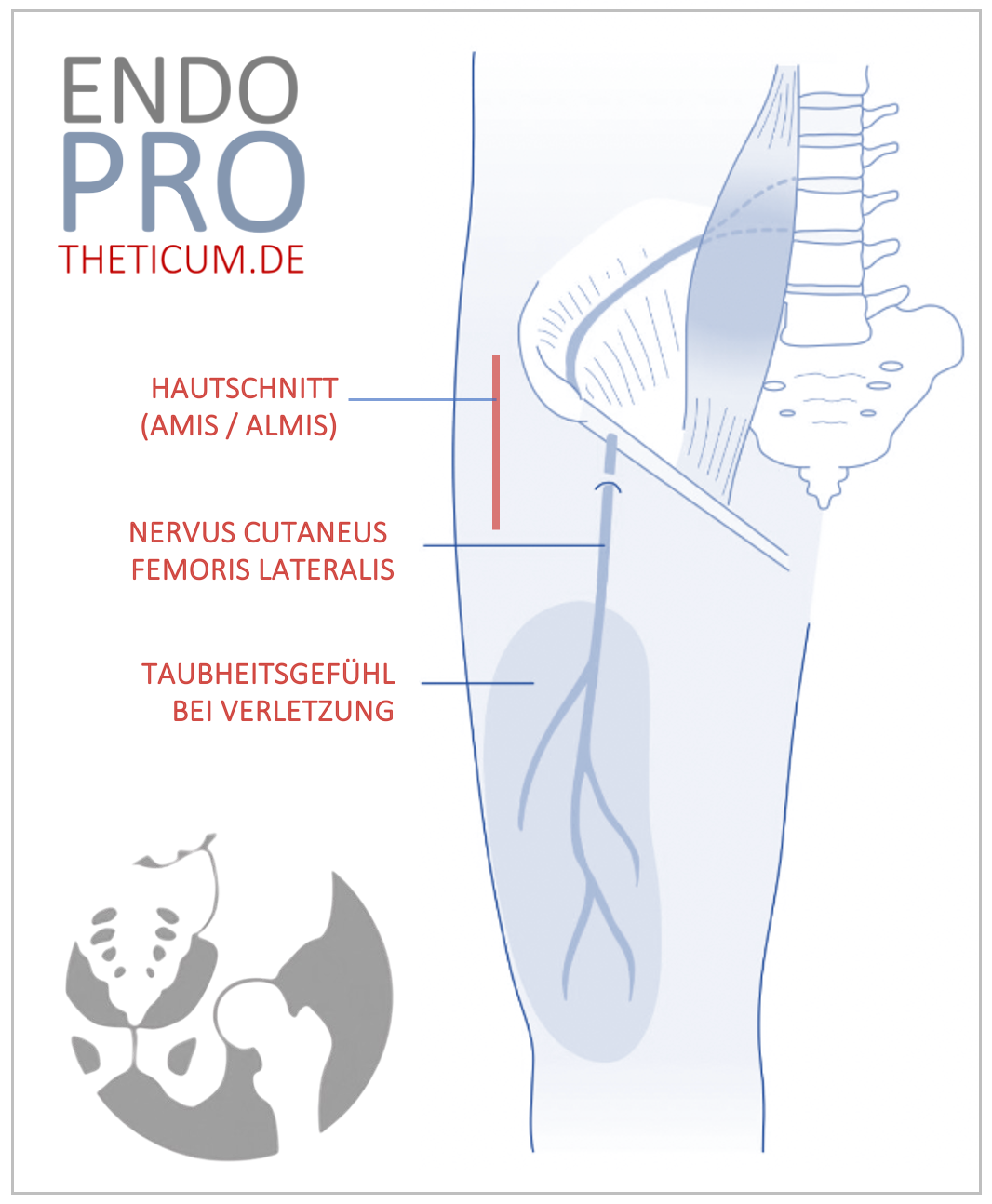
- Nerve compression : Irritation of the femoral or obturator nerve can cause neuropathic groin pain.
- Gastrointestinal causes : Diseases of the intestine, such as diverticulitis or appendicitis, can also mimic groin pain.
Common misdiagnoses of groin pain
Groin pain is frequently misdiagnosed because the symptoms of various conditions overlap. The following misdiagnoses are particularly common:
- Misinterpretation of hip pathology as a groin hernia : Early signs of coxarthrosis or FAI are often misinterpreted as a groin hernia.
- Confusion with muscular problems : Adductor problems are frequently diagnosed when a structural hip disease is present.
- Back problems as a cause : Sometimes a herniated disc or lumbar nerve root irritation is assumed to be the cause of groin pain, although the problem lies in the hip.
Conclusion: Groin pain often originates in the hip joint!
Groin pain is a complex symptom with diverse causes. It is particularly important not to overlook the hip as a possible source of the discomfort. A thorough diagnostic workup, including clinical examination, imaging, and, if necessary, interventional tests, is essential to establish the correct diagnosis and initiate effective treatment. Especially in cases of persistent or unclear groin pain, hip-related causes should always be considered.
Therefore, it is advisable to consult a hip specialist early on to rule out serious conditions and begin targeted treatment. Early diagnosis can significantly improve the prognosis and prevent long-term limitations.
MAKE AN APPOINTMENT?
You are welcome to make an appointment either by phone or online .


ENDOPROTHETICUM - The whole world of endoprosthetics